
Dyco est une équipe du laboratoire LIED de l université de Paris qui s intéresse à la thermodynamique hors d équilibre et à ses conséquences sur le monde qui nous entoure
Dyco est une équipe du laboratoire LIED de l université de Paris qui s intéresse à la thermodynamique hors d équilibre et à ses conséquences sur le monde qui nous entoure
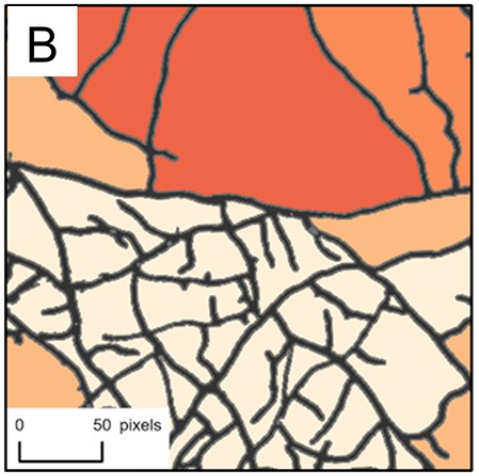
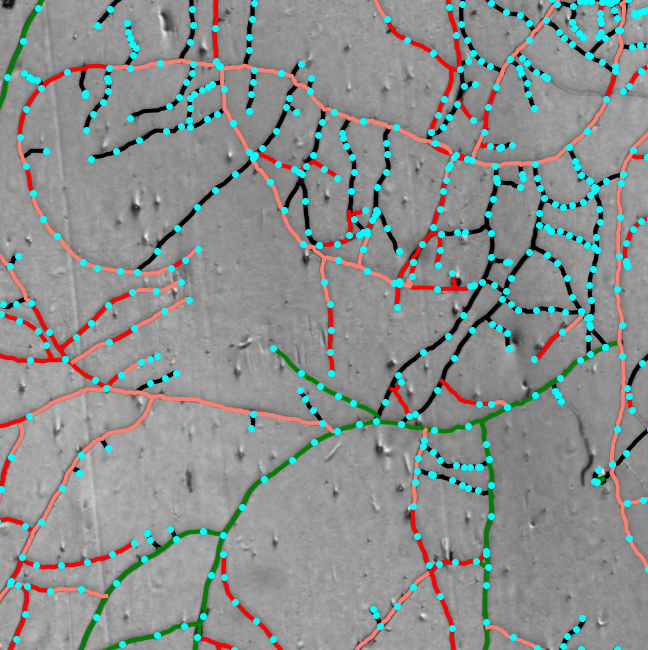
How fungi or plants invade a medium, how diseases spread over a population, how communication routes become denser or more generally how information/mass/energy evolves in networks, are ques- tions that seem to refer to quite unrelated problems. However, the structure, dynamics and shape of the underlying network can be encoded by very similar models. Ranging from simple explanatory models to more realistic approaches, these models depend on the local features of a large and possibly increasing number of time-evolving connected individuals and of their interactions in extended systems. The nature of such networks is not uniquely defined: some examples are informational networks (of relation between individuals, citation graphs …), technological (power grids, public transportation, computer network …), or biological (vascular, biochemical, neural network …). In all these examples, transformation arises from individuals, be it the development of a new connection between existing entities, as it often appears in neurons, or the introduction of a new individual in the system. All these contributions sum up to the evolution of the network as a unit on the macroscopic level. Mod- eling of such intricate processes ranges from simple explanatory toy-models to more specific approaches, that capture modifications at different scales. This can be achieved by linking microscopic objects, which describe individuals, with their collective mean behavior. Techniques bor- rowing from statistical physics for the analysis of nonlinear, non-equilibrium physical systems in the study of such collective behavior are of increasing use, in social, economical or biological systems. The expansion of such networks may also be hindered by internal or external constraints which can significantly affect the observed results and patterns. When explicitly including the spatial dimension, the models considered may provide a pertinent description of the interaction processes at the small (micro or sub-micro) scales as well as the large (macro)scales featuring the emerging behavior, possibly under the form of a (thin) propagating front. The modeling and analysis of such dynamical processes within a multiscale framework, where the different granularities of the system are to be considered, is a complex research field, that requires involving various disciplines.
The thallus of filamentous fungi is an intriguing case for growing and branching networks. It consists of an interconnected hyphal network, the mycelium, which allows an efficient spatial exploration and exploitation of the nutritive resources. Moreover, the efficient growth of filamentous fungi is adapted through a mycelial network, in particular in the presence of external constraints disturbing or impeding the environmental exploration. Note that the question of scales is here again of paramount importance: the hypha is a few microns wide (typically 4 to 6), while the mycelial network can operate on spatial scales ranging from a few millimeters up to many kilometers. In this project, we will specifically address the characterization of the expanding fungal network of the filamentous fungus Podospora anserina. Beyond the fundamental interest of better understanding how such a filamentous fungus adapts to a competitive environment, it represents a convenient lab-scale model for studying the development of filamentous fungi, or even more general living systems networks.
Growth of Podosora anserina from a single ascospore on a cellophane sheet. The fungus can access to the nutrients diffusing through the pores of the cellophane sheet. Hyphae typical diameter is 7 micrometer. The lighting of the plate is obtained by transmission through the culture medium. The camera is above the sample. the Image covers 1.09x1.74mm2. Duration between two frames is 18 minutes.
We organized two colloquium related to the project